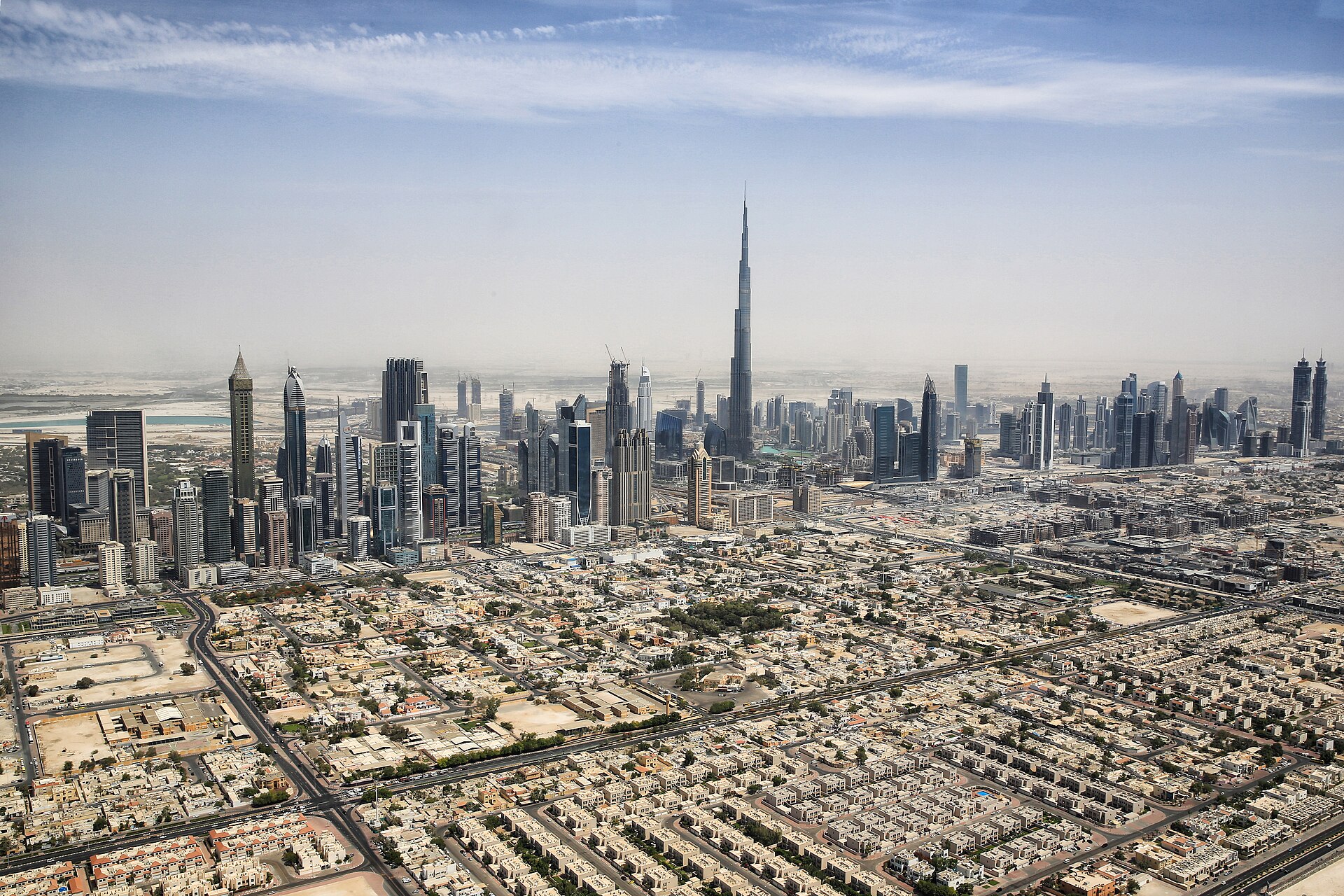
A regional financial and family-office hub built on free zones (DIFC, ADGM) with independent common-law courts, which has drawn wealthy families and fund managers from across Asia, Europe, and Africa.
0%personal income tax
0%capital gains tax
0%withholding tax on dividends
4–7%typical dividend yields on DFM and ADX
Capital
Abu Dhabi
Currency
UAE dirham (pegged to the US dollar)
Main exchange
Dubai Financial Market (DFM) & Abu Dhabi Securities Exchange (ADX)
Regulator
Securities and Commodities Authority (SCA); DIFC and ADGM operate as separate offshore financial free zones
How people invest in United Arab Emirates
Real estate — especially in Dubai — is the most visible asset class; gold trading has deep historical roots (the Dubai Gold Souk); family offices and private banking manage a large and growing share of regional wealth; DFM/ADX equities round out the picture.
Real estateGoldFamily officesDFM/ADX equities
Getting access
Residents and international investors face completely different mechanics here, so they are set out separately rather than blended into one set of instructions.
Living in the UAE
Opening an account as a resident
The UAE's tax position is the simplest of any market on this site: there is no personal income tax, no capital gains tax and no withholding tax on dividends. What you earn is what you keep, locally.
Open an account with a broker licensed by the Securities and Commodities Authority, plus an investor number with the exchange you intend to trade.
Trade the Dubai Financial Market and the Abu Dhabi Securities Exchange in dirhams. Both are dividend-oriented markets — yields of roughly 4% to 7% are common, and entirely untaxed locally.
Understand the currency position. The dirham is pegged to the US dollar, so a UAE resident holding dollar assets carries very little currency risk — one of the strongest practical advantages of investing from here.
For global exposure, international brokers are widely used and there is no exchange control preventing you from investing abroad.
DIFC and ADGM are separate common-law financial free zones with their own regulators, and much of the region's wealth management operates from them rather than onshore.
The absence of local tax makes your home country's rules the binding constraint, not the UAE's. Citizens of countries that tax on citizenship or that have strict residency tests can find their real tax position is unchanged by being here — and that is a question to settle before, not after.
International
Investing in the UAE from outside
The UAE markets are open to foreign investors, and the more interesting question for most is whether the listed market is what they actually want from the region.
Foreign investors can access DFM and ADX through local brokers, with foreign ownership limits set company by company rather than market-wide.
The listed markets are concentrated in banks, real estate, utilities and energy-linked names. They are income markets rather than growth markets.
For most individuals a Gulf or MENA ETF provides the exposure without local account arrangements.
Property is the asset most foreign capital actually comes for, and Dubai in particular permits freehold ownership by foreigners in designated areas — unusual in the region.
Dividend yields here are high by global standards and are untaxed at source. For an income investor whose home jurisdiction taxes lightly, that combination is genuinely rare.
What you can actually buy
The UAE is an income market wrapped around a property market, and the tax treatment shapes both.
DFM and ADX equities
Both
Banks, real estate developers, utilities and energy-linked companies dominate. Dividend yields of 4% to 7% are common.
The local mechanic: No capital gains tax and no dividend withholding locally. The effective tax depends entirely on where you are tax resident, not where the shares are.
Residential property
Both
Foreigners can own freehold in designated areas, which is rare regionally and is the main draw for international capital.
The local mechanic: Transfer fees and service charges are the real ongoing costs, and off-plan purchases carry developer completion risk that the market has tested before.
Global assets held from the UAE
Residents
With no exchange control and a dollar-pegged currency, UAE residents can build globally diversified portfolios with unusually little friction.
The local mechanic: The peg means a resident buying US assets takes almost no currency risk — the single most underrated advantage of investing from here.
Sukuk and Islamic products
Both
A well-developed segment, with Dubai positioning itself as a global sukuk listing venue.
The local mechanic: Sharia screening excludes conventional banks, which in these bank-heavy indices is a very large structural tilt.
The fund and ETF route
Fund access is broad and the choice is mostly about domicile and your own tax residence.
Vehicle
Type
For
Notes
Locally listed ETFs
Listed ETF
Both
A small and growing segment; liquidity is the constraint.
Ireland-domiciled UCITS
Listed ETF
Residents
The common choice for globally diversified exposure, largely for the US withholding tax position.
US-domiciled ETFs
Listed ETF
Residents
Cheap and deep, but non-US holders face 30% dividend withholding and potential US estate tax exposure above a low threshold — a risk widely overlooked in the Gulf.
MENA and Gulf ETFs
Listed ETF
International
The straightforward route for foreign individuals wanting regional exposure.
The UAE has become the region's dominant hub for private capital, family offices and venture funding.
DIFC and ADGM operate under common law with their own courts and regulators, which is why most regional fund structuring happens there rather than onshore.
Sovereign wealth funds are the defining feature of the regional capital landscape and are increasingly active as direct investors.
For individuals, access runs through licensed intermediaries in the free zones, and the professional-investor thresholds are the gate.
Introduced for companies; does not create a personal investment tax
The UAE introduced a corporate tax on business profits, which does not create a personal income or capital gains tax for individual investors. Your own country of citizenship or tax residence may tax you regardless — US citizens in particular remain within the US tax net wherever they live. This is general information rather than tax advice, and cross-border position is where the real complexity sits.
Risks worth pricing in
International
What international investors should weigh
A zero-tax market is attractive and the underlying assets still have to work:
These are income markets, not growth markets. Banks, property and utilities dominate. High dividend yields are the return, and expecting capital growth on top is a different thesis than the index supports.
Concentration in property and energy runs through everything. Real estate developers and banks lending to them, plus energy-linked revenue, mean the index is far less diversified than the sector labels suggest.
The peg imports US monetary policy. The dirham's dollar peg removes currency risk for dollar-based investors and means local rates follow the Federal Reserve regardless of regional conditions — which transmits directly into the property market.
Liquidity is thinner than the market caps imply. Free floats are limited on many listings, with substantial state and family ownership. Headline capitalisation overstates how much stock actually trades.
Residents
What residents should weigh
The tax position is unmatched. The risks are about what people do with it:
Your home country may still tax you. The UAE's zero-tax position is only half the equation. Citizenship-based taxation and residency tests elsewhere can leave your actual liability unchanged, and this is worth resolving before building a portfolio around the assumption.
US-domiciled funds carry estate-tax exposure. Non-US investors holding US-domiciled ETFs can face US estate tax above a threshold far lower than most expect. In a market full of expatriate investors defaulting to US products, this is a common and avoidable exposure.
Residency is tied to employment for many. For expatriates, losing a job can mean losing residency on a short timeline. Illiquid local assets, particularly property, are difficult to unwind at speed under that pressure.
Property is where leverage concentrates. Off-plan purchases carry completion risk, and the market has been through sharp corrections. High yields are compensation for a real cycle, not a free lunch.
How the market got here
The UAE built its financial markets from nothing in twenty-five years, and its free zones are the reason regional capital stayed.
2000The Abu Dhabi Securities Exchange and the Dubai Financial Market are established.
2004The Dubai International Financial Centre opens as a common-law financial free zone.
2013Abu Dhabi Global Market is established as a second common-law free zone.
2014The UAE is upgraded to emerging market status by MSCI.
2021Long-term residency visas are expanded, changing the calculus for expatriate wealth.
2023A federal corporate tax on business profits takes effect, leaving personal investment income untaxed.
Trends shaping United Arab Emirates
Regional investing patterns that show up strongly in United Arab Emirates — read the full analysis in investing trends.
Not locally. There is no personal income tax, no capital gains tax and no withholding tax on dividends. A federal corporate tax applies to business profits but does not create a personal investment tax. What matters instead is your country of citizenship or tax residence, which may tax you regardless.
Can foreigners buy property in the UAE?
Yes, freehold in designated areas — most extensively in Dubai. This is unusual in the region and is the main reason international capital comes here. Transfer fees and service charges are the meaningful ongoing costs, and off-plan purchases carry developer completion risk.
What are DIFC and ADGM?
Financial free zones operating under common law with their own courts and regulators, in Dubai and Abu Dhabi respectively. Most regional fund structuring, private banking and wealth management operates from them rather than onshore, because the legal framework is familiar to international investors.
Why does the currency peg matter?
The dirham is pegged to the US dollar, so a UAE resident buying dollar-denominated assets takes almost no currency risk. That is a genuine and underrated advantage. The cost is that local interest rates follow the Federal Reserve regardless of regional conditions, which transmits directly into property.
Are UAE stocks a growth investment?
Generally not. DFM and ADX are dominated by banks, real estate and utilities, with dividend yields commonly in the 4% to 7% range. They are income markets. Expecting index-level capital growth on top of that yield is a different thesis from what the constituents support.
Rates, thresholds and regulatory references on this page were last verified on . United Arab Emirates's rules are moving quickly — confirm anything you intend to act on against a primary source or a qualified adviser. Nothing here is investment, legal or tax advice.